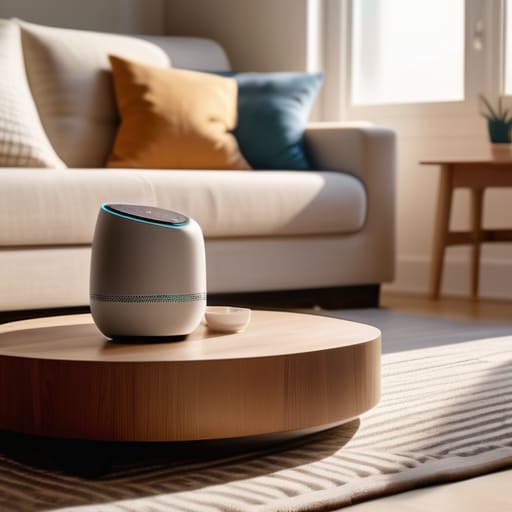
I was in my workshop last Tuesday, mid-way through stripping a stubborn layer of lacquer off a 1958 teak sideboard, when my smart speaker suddenly chimed in to tell me the weather. I wasn’t even talking to it; I was just breathing heavily from the manual labor. It was one of those jarring, uninvited moments that makes me wonder why we’re so obsessed with voice assistant adoption in the first place. We’ve been sold this glossy vision of a seamless, hands-free life, but more often than not, it feels like we’re just inviting a tiny, eavesdropping stranger to sit in the corner of our most private spaces.
I’m not here to tell you that these gadgets are magic, nor am I going to preach that they’re pure evil. Instead, I want to look at the actual friction between these tools and our daily rhythms. Over the next few sections, I’ll be sharing a pragmatic breakdown of where this tech actually earns its keep and where it’s just digital noise masquerading as progress. My goal is to help you decide if bringing a voice assistant into your home is an act of convenience or a surrender of your peace.
Table of Contents
Decoding the Surge in Smart Home Ecosystem Growth
It feels like every time I walk into a friend’s house lately, there’s another glowing ring on a countertop or a new speaker tucked into a bookshelf. We aren’t just buying gadgets anymore; we are building entire digital habitats. This smart home ecosystem growth isn’t happening by accident. It’s the result of these devices finally learning how to talk to one another, creating a seamless—if slightly overwhelming—web of connectivity that aims to anticipate our every need.
But as these systems become more integrated, the complexity behind the scenes is staggering. We’re seeing massive leaps in speech recognition accuracy improvements, which makes the interaction feel less like talking to a machine and more like a natural dialogue. However, as we lean harder into these seamless interfaces, I can’t help but wonder about the invisible cost. When our lights, our locks, and our thermostats are all part of the same conversation, the line between “convenient automation” and “constant surveillance” starts to get incredibly thin. We are trading a bit of our domestic solitude for the sake of a frictionless life.
Ai Conversational Intelligence Tool or Replacement
We’re moving past the era of “Hey Alexa, play some jazz” and entering something much more complex. With recent leaps in AI conversational intelligence, these devices are starting to feel less like glorified timers and more like actual participants in our daily lives. They can follow context, remember past interactions, and even mimic the cadence of a real person. But as a sociologist by training, I can’t help but feel a twinge of unease. We are rapidly shifting from using a tool to engaging in a simulation, and that distinction matters.
The real question isn’t just about how much better the speech recognition accuracy improvements have become—though, let’s be honest, it’s impressive. The real question is whether we are outsourcing our cognitive heavy lifting to a machine. When we rely on an algorithm to manage our schedules, suggest our meals, or even mediate our moods, we risk losing that essential bit of human friction that keeps us sharp. We need to ensure these advancements remain assistants rather than proxies for our own decision-making.
Reclaiming Control: How to Integrate Voice Tech Without Losing Your Mind
- Audit your “always-on” footprint. Before you drop a new smart speaker in the kitchen, ask yourself if that specific room actually needs a listening ear, or if you’re just inviting digital noise into a private space.
- Prioritize interoperability over brand loyalty. Don’t get trapped in a single ecosystem just because of a flashy marketing campaign; choose devices that play well with others so you aren’t locked into one company’s way of thinking.
- Set hard boundaries for automation. Use voice commands to handle the mundane—like setting timers or checking the weather—but resist the urge to automate complex tasks that require actual human judgment and nuance.
- Master the privacy settings from day one. Don’t wait for a data leak to care about your history logs. Go into the settings immediately and purge your voice recordings regularly; treat your digital data with the same respect you give your physical mail.
- Keep a manual fallback. Technology is a tool, not a crutch. Always ensure your most essential home functions—lights, locks, thermostats—can still be operated by hand when the Wi-Fi inevitably decides to take a nap.
The Bottom Line: Navigating the Voice Revolution
We have to stop treating voice assistants as mere gadgets and start seeing them as permanent fixtures in our domestic and professional architecture; once they’re in, they change how we interact with our space.
Convenience is the ultimate bait, but we must remain vigilant about the trade-off between a frictionless life and the quiet loss of our personal privacy and decision-making autonomy.
The goal isn’t to achieve a fully automated existence, but to ensure these tools serve us as efficient assistants rather than becoming noisy, intrusive masters of our daily routines.
The Cost of Convenience
“We’re being sold the dream of a frictionless life, but I can’t help but wonder if we’re actually building a world where we’ve traded our basic agency for the ability to turn off a lightbulb without standing up.”
Yvette Marchetti
The Human Bottom Line
We’ve looked at how smart home ecosystems are expanding at a breakneck pace and whether conversational AI is actually helping us communicate or just creating a new kind of digital dependency. The reality is that voice assistant adoption isn’t just a technical shift; it’s a fundamental change in how we inhabit our private spaces. While the convenience of a hands-free kitchen or a voice-activated light switch is undeniably tempting, we can’t ignore the trade-offs in privacy and the subtle erosion of our cognitive autonomy. If we aren’t careful, we risk turning our homes into data-collection hubs disguised as helpful companions, trading our quietest moments for algorithmic efficiency.
As we move forward into this increasingly vocal era, my advice is to remain the architect of your own environment. Technology should serve as a tool that fits into the margins of your life, not a central authority that dictates your rhythm. Don’t be afraid to unplug, to silence the microphones, or to choose the manual way of doing things simply because it keeps you present. Real progress isn’t about how many devices can hear us; it’s about ensuring that we still have the freedom to be silent on our own terms. Let’s make sure we are using the tech, rather than letting the tech use us.
Frequently Asked Questions
At what point does the convenience of a voice-controlled home start to compromise our actual privacy and data security?
It starts the moment you stop seeing the device as a tool and start seeing it as a roommate. We cross that line when the “convenience” requires a constant, unblinking ear in our most private spaces. If you’re hesitant to discuss a medical issue or a sensitive work matter because you’re worried about a “trigger word” being logged, you’ve already lost your autonomy. Real convenience shouldn’t feel like surveillance.
How do we prevent these devices from becoming another layer of digital clutter that actually complicates our daily routines instead of simplifying them?
The trick is to stop treating every new gadget like a mandatory upgrade. I’ve learned through restoring old furniture that if a piece doesn’t serve a functional purpose, it’s just clutter. Apply that same rigor to your tech. Before you add a new device, ask: does this solve a friction point, or am I just adding another thing to manage? If it requires more troubleshooting than it saves in time, leave it on the shelf.
Is there a risk that relying on AI for basic verbal interactions will erode our ability to communicate effectively with the people sitting right in front of us?
I worry about it constantly. When we outsource our basic verbal needs to a machine, we lose the “muscle memory” of nuance—the pauses, the eye contact, the subtle shifts in tone that define real connection. If we get too comfortable barking commands at a speaker, we might find ourselves losing the patience required for the messy, unpredictable, and beautiful friction of a real human conversation. We’re trading depth for convenience, and that’s a steep price.
