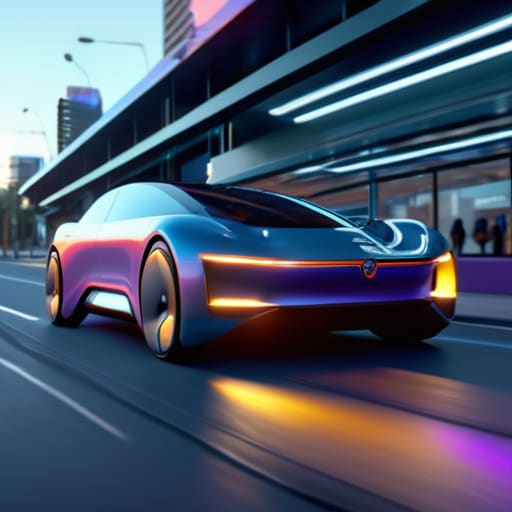
I was sitting in my driveway last Tuesday, sanding down the legs of a vintage teak sideboard, when a sleek, sensor-laden prototype glided silently past my house. It looked less like a car and more like a rolling smartphone, a perfect embodiment of the relentless push toward autonomous vehicle technology. Every tech evangelist on my feed is screaming about how this is the ultimate liberation from the drudgery of the commute, but I couldn’t help but feel a twinge of skepticism. We are being sold a dream of seamless mobility, yet no one seems to be talking about what happens to our sense of agency when we hand the steering wheel over to a black box of code.
I’m not here to tell you how many sensors a LIDAR system has or to recite a press release about “optimized urban flow.” Instead, I want to look at what this shift actually means for our daily lives and our autonomy. I promise to strip away the marketing gloss and explore whether these advancements are truly designed to grant us more freedom, or if we are simply trading our competence for a polished, automated convenience.
Table of Contents
- Decoding the Levels of Vehicle Automation
- Machine Learning in Self Driving Systems Tool or Tyrant
- Staying Human in the Driver’s Seat: 5 Ways to Navigate the Automation Shift
- The Bottom Line: Navigating the Shift to Autonomy
- The Illusion of Control
- The Road Ahead: Agency Over Automation
- Frequently Asked Questions
Decoding the Levels of Vehicle Automation
To make sense of the hype, we have to look past the marketing gloss and actually understand the levels of vehicle automation. It isn’t a simple binary of “driver” versus “no driver.” Instead, it’s a sliding scale that ranges from basic driver assistance—think cruise control or lane departure warnings—to full, hands-off autonomy. Most of what we see on the road today sits in that middle ground, where the car is essentially a co-pilot, constantly asking the human to stay vigilant.
The real complexity lies in how these machines actually “see” the world. To move up that scale, a vehicle relies heavily on computer vision for autonomous driving, using a suite of cameras and sensors to interpret a chaotic environment in milliseconds. It’s one thing for a computer to identify a stop sign in a controlled test; it’s quite another to distinguish a cardboard box blowing across the highway from a small child stepping off a curb. As we push toward higher levels of autonomy, the margin for error shrinks, and the reliance on these digital eyes becomes absolute.
Machine Learning in Self Driving Systems Tool or Tyrant
When we talk about the “brain” of these cars, we’re really talking about machine learning in self-driving systems—a complex web of algorithms trying to make sense of a chaotic world. It isn’t just about following a programmed map; it’s about the car learning to recognize the difference between a plastic bag blowing in the wind and a toddler stepping off a curb. This relies heavily on computer vision for autonomous driving, which essentially gives the vehicle eyes. But there’s a tension here that keeps me up at night. We are essentially teaching machines to make split-second, life-or-death decisions based on patterns they’ve identified in data, not through actual human intuition or moral reasoning.
The real question is whether this technology remains a tool under our control or becomes a digital tyrant dictating our movements. While real-time obstacle detection technology has made incredible strides, we are still outsourcing our survival to a black box. If the system encounters a scenario it hasn’t been trained for, can we truly trust it to prioritize human life over mathematical efficiency? We shouldn’t let the sheer complexity of the math mask the fundamental need for human oversight and accountability.
Staying Human in the Driver’s Seat: 5 Ways to Navigate the Automation Shift
- Don’t outsource your intuition; even with advanced driver-assistance systems, keep your eyes on the road and your hands ready to take control when the sensors get confused by a sudden storm or a construction zone.
- Audit your “convenience” addiction by asking if a new semi-autonomous feature actually saves you time, or if it’s just a way to make you more distracted and less present in your own life.
- Demand transparency from manufacturers regarding how their software handles edge cases—we shouldn’t have to play guessing games with the algorithms that decide when to brake or steer.
- Maintain your manual skills as a safety net; there is a certain cognitive muscle memory that comes with driving that disappears quickly when you let the car do all the thinking.
- Prepare for the “handoff” problem by understanding that the most dangerous moment in an autonomous vehicle isn’t when it’s driving, but the split second it asks a distracted human to suddenly become an expert pilot.
The Bottom Line: Navigating the Shift to Autonomy
Automation isn’t a binary switch between “on” and “off”; we are moving through a messy, incremental spectrum of control that requires us to stay vigilant about when we are truly handing over the reins.
We must distinguish between technology that serves our mobility and systems that merely optimize for data collection, ensuring that “convenience” doesn’t become a euphemism for losing our agency.
Real progress in autonomous transit won’t be measured by how sophisticated the code is, but by whether these vehicles actually return time and freedom to our lives or just create new, digital forms of friction.
The Illusion of Control
We keep talking about the “magic” of self-driving cars as if efficiency is the only metric that matters, but we’re missing the real question: are we designing these systems to serve our autonomy, or are we just building more expensive ways to surrender our agency to a line of code?
Yvette Marchetti
The Road Ahead: Agency Over Automation
We’ve spent a lot of time dissecting the mechanics here, from the rigid hierarchy of automation levels to the complex, often opaque logic of the machine learning models driving them. It is easy to get lost in the technical wizardry and forget that these aren’t just upgrades to our hardware; they are fundamental shifts in how we interact with the physical world. As we move from driver assistance to full autonomy, we aren’t just changing how we get from A to B—we are renegotiating our relationship with control. If we aren’t careful, we risk letting the pursuit of efficiency strip away the very human agency that makes travel more than just a logistical transaction.
Ultimately, the success of autonomous technology shouldn’t be measured by how many miles it can cover without a human touch, but by how much meaningful time it restores to our lives. If self-driving cars mean we can finally stop staring at brake lights and start engaging with our families or our thoughts, then we’ve won. But if we simply trade the steering wheel for a digital leash that dictates our every move, we’ve lost the plot. Let’s ensure that as we build these smarter systems, we are building them to serve our freedom, not to quietly automate our existence away.
Frequently Asked Questions
If we hand the wheel over to an algorithm, who actually holds the liability when something inevitably goes wrong on a rainy Tuesday?
That’s the million-dollar question, and frankly, the legal system isn’t even close to having a straight answer. Right now, we’re stuck in this messy gray area between driver negligence and product liability. If a sensor fails in a downpour, is it your fault for not intervening, or the manufacturer’s for a software glitch? We’re rushing toward automation without building the legal safety nets required to handle the fallout when things inevitably break.
Are we actually solving traffic congestion, or are we just creating a world where more people sit idle in cars instead of finding more efficient ways to move?
That’s the million-dollar question, isn’t it? We’re being sold the dream of seamless, frictionless travel, but I worry we’re just optimizing for “idleness.” If autonomous cars make commuting less stressful, people might actually choose longer, more frequent trips rather than moving closer to work or taking a train. We risk turning our streets into high-tech parking lots where everyone is “productive” on a laptop, but no one is actually moving efficiently.
How do we ensure that the transition to autonomous fleets doesn't leave behind the millions of people whose livelihoods depend on driving?
This is the part where the hype cycles usually go silent, and that’s exactly where we need to lean in. We can’t just treat drivers like obsolete hardware to be swapped out. Transitioning to autonomous fleets requires more than just retraining programs; it requires a serious conversation about social safety nets and meaningful career pivots. If we don’t bake human dignity into the economic model now, we’re just building a future that works for machines, not people.
